How Matchmaking Introductions Shape Your First Message
Matchmaking introductions can come through family, friends or a service. Learn what to clarify and how to write a first message that leaves room to choose.
The common mistake with matchmaking introductions is assuming the route tells you how serious the other person is. That can lead to a first message that speaks for them before you have even met. Start instead with what you know: who connected you, what they shared and whether the other person expects to hear from you.
A family member, mutual friend or matchmaking service can each provide a different amount of context. The same route can also mean different things to different people. Rather than treating any introduction as a promise or a verdict, use it to open a direct, low-pressure conversation.
What does the introduction actually tell you?
An introduction tells you how contact began. It may also tell you what the introducer hoped would happen, but those are not necessarily the same thing as the other person’s wishes. A family member might intend a serious match; a friend might simply think you would enjoy talking.
Keep those distinctions clear. If you do not know what the other person has been told, ask the introducer a simple question before writing: “What did you share with them, and did they say they were happy for me to get in touch?” Their answer can help you avoid surprising someone or claiming more shared intent than exists.
Use the introduction as context, not as evidence of compatibility.
How do family, friends and services differ?
Each route can offer useful context, but the details depend on the people involved. A family introduction may come with relatives’ hopes. A friend may know something about both people’s interests. A matchmaking service may pass along preferences each person has chosen to share. None of these routes tells you, by itself, how much the other person wants to talk.
Family or community introduction
You may know who passed along the contact and why they thought of you. If relatives are involved, consider whether both people can speak directly and decide for themselves what follows. A respectful opening can name the connection and ask whether the other person is comfortable chatting.
Friend-led introduction
A mutual friend can provide a natural point of conversation, but avoid treating their recommendation as the other person’s agreement. Ask what the friend has already shared, then mention only the context you know to be true.
Matchmaking service or independent connection
A service may introduce people using information they have provided, while an independent connection may offer little background. In either case, say briefly how you came across the person and let them decide whether to continue the conversation.
What should you clarify before sending a message?
Check the practical details before composing an opener. The following list pairs each observation with a decision and an alternative action:
- If the introducer confirms the other person agreed to be contacted, name the introduction and send a short, friendly message; if they did not confirm this, ask the introducer to check first.
- If you know exactly what was shared about you, refer only to that information; if you are unsure, leave personal claims out and ask the introducer what they said.
- If the introduction was meant as a casual conversation, use a light opener and invite a reply; if the stated intention was more serious, still ask whether the person wants to talk directly rather than presuming agreement.
- If a relative or friend expects to manage the exchange, say you would prefer to speak directly; if the other person wants an intermediary present, clarify what arrangement feels comfortable to both of you.
- If you have a genuine shared interest to mention, ask one open question about it; if no shared interest is known, introduce yourself plainly instead of inventing one.
- If you feel pressured to write before you understand the introduction, pause and ask for clarification; if you are comfortable proceeding, keep the message brief and easy to decline.
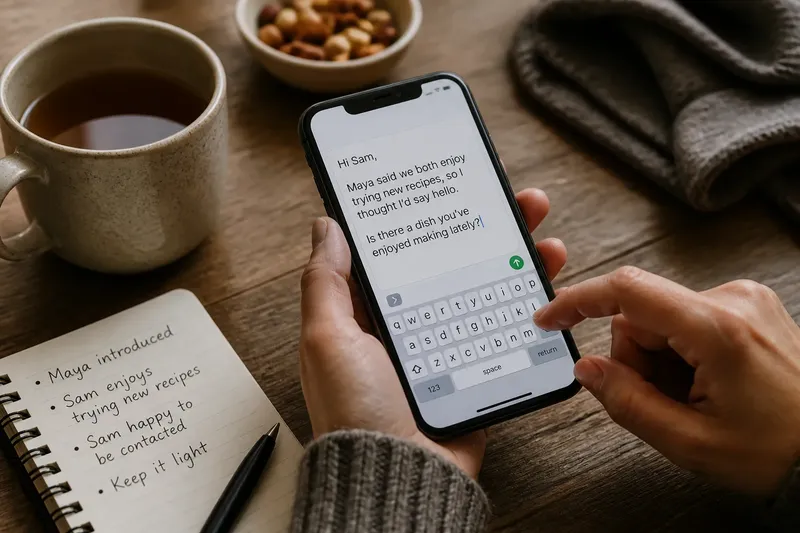
Say Maya introduces you to Sam and tells you both enjoy trying new recipes. You ask Maya whether Sam knows you may get in touch; she confirms Sam agreed, and says she mentioned only the cooking interest. You write: “Hi Sam, Maya said we both enjoy trying new recipes, so I thought I’d say hello. Is there a dish you’ve enjoyed making lately?” The message uses the confirmed context without suggesting Maya promised a match. If Maya had not checked with Sam, the next action would be to ask her to do so before sending anything.
A useful message names the connection, stays within what you know and leaves the next move open.
What questions do people ask about matchmaking introductions?
Does an arranged introduction mean the couple has no choice?
No single answer fits every family or community. Ask what each person has agreed to and whether they can speak privately and decide whether to continue.
How is a matchmaking service different from a family introduction?
A service usually acts as an intermediary, while a family introduction comes through personal relationships. The amount of information shared and the intermediary’s role can differ in either case, so clarify those details.
Should you mention who introduced you?
Usually, naming the connection helps explain why you are writing. Keep it brief, and do not imply the introducer can speak for the other person’s interest.
What if the other person does not reply?
Give them room to decide whether to respond. If you send a follow-up, keep it courteous and avoid repeated messages or asking the introducer to pressure them.
How can you keep the introduction from speaking for you?
Introduce yourself in your own words, even when someone else created the connection. You might say what prompted you to reach out, ask a simple question and let the other person answer on their own terms. Avoid presenting family approval, a friend’s enthusiasm or a service’s match as proof that you will suit each other.
If the expectations are unclear, address that gently before either person feels committed. For example, you can say that you are happy to chat and ask what the other person understood about the introduction. That small clarification can make the exchange more comfortable and keep each person responsible for expressing their own interest.
The search phrase matchmaking introductions may bring to mind a particular route, but the useful details are more personal: what was shared, who has agreed to be contacted and what each person wants to do next. Keep those facts separate from the introducer’s hopes, and your first message can begin a conversation without deciding its outcome.